
By Evelyn Lam
Opinion Editor
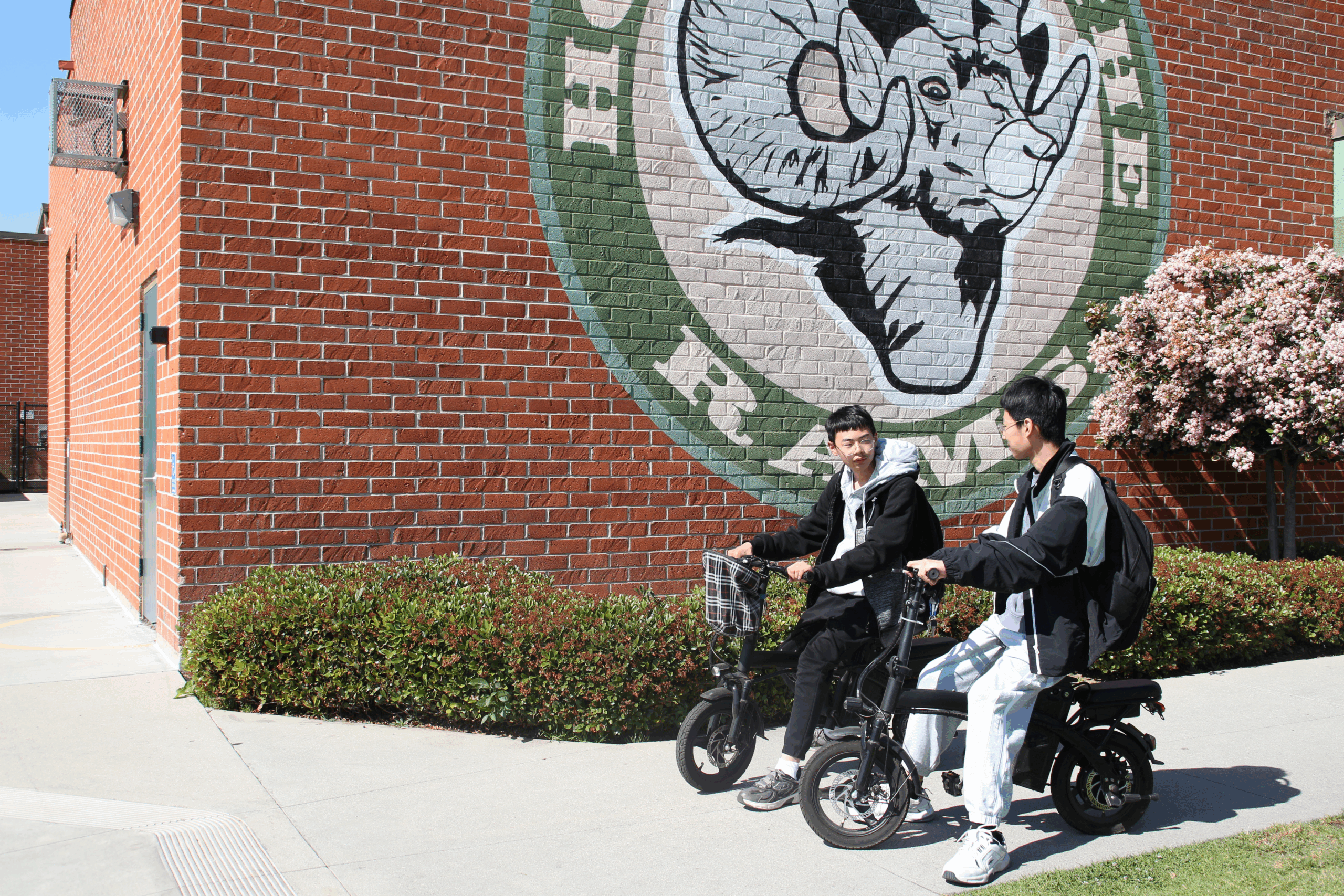
PHOTO/ Tara Aung
Freshman Yixin Qiu and junior Yexin Qiu rely on e-bikes for transportation to and from school every day. According to the medical journal JAMA network, electric bicycle injuries increased by nearly 100% annually from 2017 to 2022.
The district’s Director of Student Services, Daryl Topalian, and a local sheriff deputy identified and relocated illegal e-bikes to the school office on May 7.
“They didn’t take away the bike,” an anonymous student rider said. “The cops and the school gave us a warning instead, so I’m very grateful.”
E-bikes are bicycles with an electric motor that assists the rider with pedaling. To be considered an e-bike, the vehicle must have operable pedals and an electric motor that does not exceed 750 watts. There are three types or classes of e-bikes. Both Class 1 and Class 2 e-bikes have a maximum motor-assisted speed of 20 miles per hour, while Class 3 e-bikes can go up to 28 miles per hour.
“The bike is my only transportation to school, but they said I wouldn’t be able to ride it anymore,” the student said. “I’ll be taking the bus instead, and I think that parents and students will start being more aware of the rules.”
California Assembly Bill 1096 also requires labeling for all e-bikes manufactured after 2017.
“There’s supposed to be a sticker on them that says that it will not exceed 28 miles per hour,” Assistant Principal Anthony Chan said. “If it doesn’t have operable pedals, it can be considered a motorcycle.”
Starting on Jan. 1, 2026, Class 1 and Class 3 e-bikes cannot be powered by throttles (devices that engage motors without pedaling) when riding, meaning they must be consistently physically operated. Class 2 e-bikes can be exclusively powered by the throttle without pedalling but may not exceed a speed limit of 20 miles per hour.
There is no age requirement to ride Class 1 and 2 e-bikes, but riders must be a minimum of 16 years old to operate Class 3 e-bikes. Riders under 17 years old are required to wear a helmet regardless of the bike’s classification.
“[The school and city] didn’t really pay attention when I started riding a long time ago, but now more and more people are riding,” junior Isaac Chan said. “It’s starting to become a problem because some people don’t know how to control themselves.”
“I was riding at night, and I had lights,” another anonymous student who was hit by a car while on his e-bike said. “The driver drove away after.”
E-bike riders also recently faced encounters with law enforcement. The Los Angeles County Sheriff’s Department Official Temple Station Instagram page posted on April 12 that deputies arrested an electric bicyclist for reckless driving.
“I think selective discipline would be better,” Chan said. “Most of the kids that ride at our school are responsible and are using it as transportation. Most of them are freshmen who can’t drive for another two years, so this might be their only way to get to school.”
School administrators and city officials intend to inform families and students about e-bike safety through Neighborhood Watch Meetings, flyers containing a link to a free California Highway Patrol E-bike Training Course, campus inspections and visits at Back to School Night.
“The endgame is that we want kids to be safe,” Principal Elena Li said. “I’ve had two of my students over the years pass away from motorcycle accidents, and it just kills me to go to their funerals. In the end, that’s what it’s about—your protection.”