GRAPHIC/ Bette Trinh
By Sofie Chan
Cover Editor
People often struggle to take the legitimacy of my interests seriously, interrogating me on how much I know about Batman and claiming that I only like sports for the “hot athletes.” As a girl, some boys doubt me for preferring superhero figurines and punk rock bands over Barbies and Taylor Swift. Sexism has conditioned us to automatically assume that girls are “posers” who fake their interest in masculine things to make themselves seem more appealing to men, clearly reflecting a greater issue of the world’s narrow expectations for gender expression.
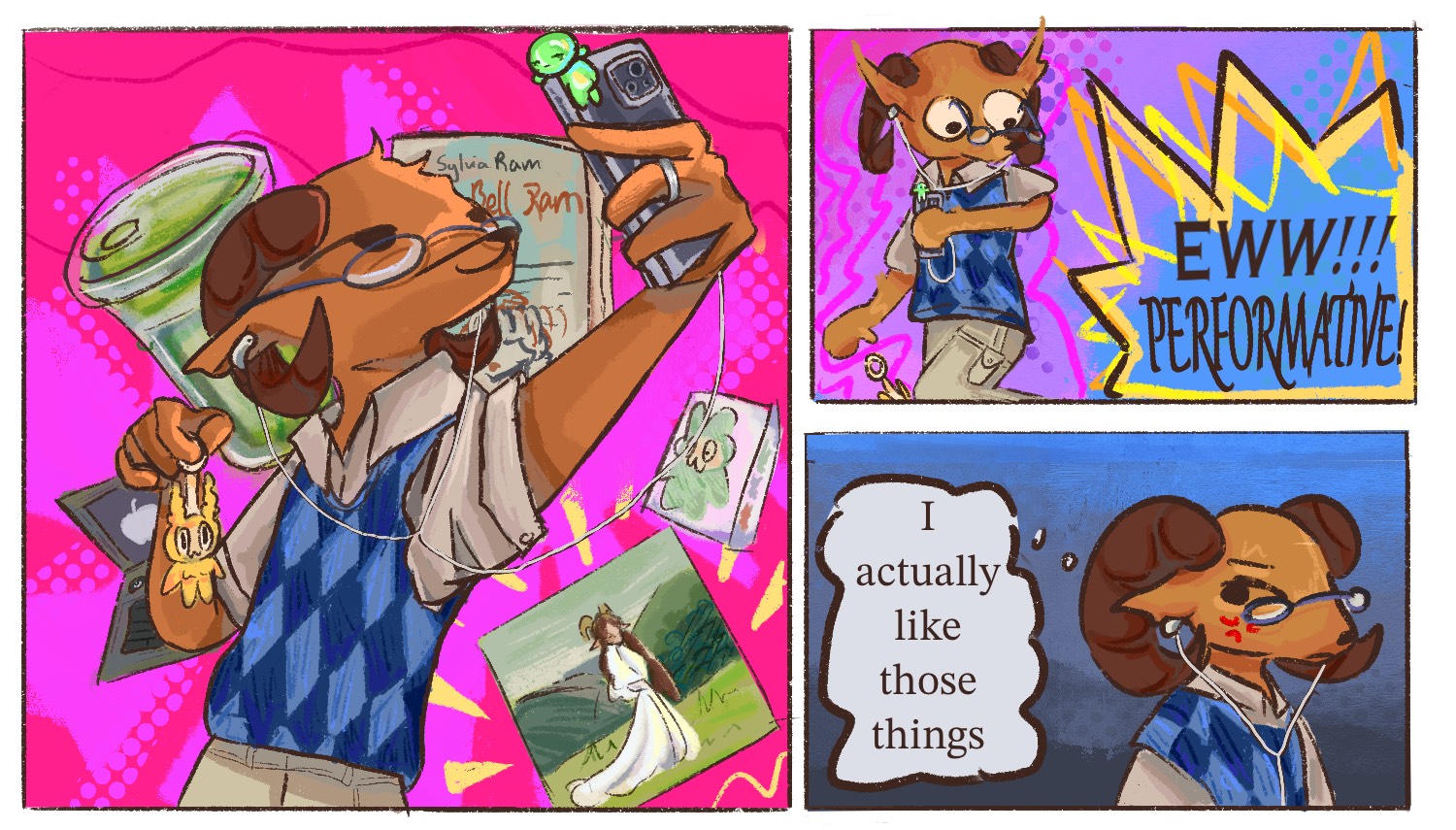
But girls aren’t alone when it comes to these standards. The “performative male” meme, a satirical depiction of men who cater to the female gaze, has dominated recent social media trends. I recognize that the meme is meant to counter the ridicule women face for their unconventional interests, and it’s refreshing to see the roles reversed after all the times I’ve been grilled about my knowledge or called a fake fan.
However, satire is often a double-edged sword; while the performative male stereotype spotlights the irony of men who lack authenticity, it also risks misinterpretation and reinforces rigid gender roles. The trademarks of a performative male are traits that stereotypically appeal to a wide range of women—including drinking matcha, reading feminist literature, being all about emotional connectivity and listening to Clairo via wired earbuds.
While it is absolutely true that some men do this to manipulate their image, the meme’s escalation discounts those who genuinely want to partake in stereotypically feminine activities, educate themselves on women’s experiences and challenge our society’s patriarchal views.
Gender is ultimately a construct defined by what is deemed acceptable by the times, and everyone experiences their gender differently. Calling anybody who does not conform “performative” erases the nuances of gender expression and implies that there is a default state.
At a time where two-thirds of young men follow masculinity influencers, this could lead to negative repercussions. As UCLA gender studies professor Dr. Juliet Williams said to The Independent, implying that men are posers for engaging in things associated with the performative stereotype “is not necessarily coming from a feminist demand for greater authenticity…[but] at a moment when masculinity [in relation to manosphere influencers like Andrew Tate] is really doubling down.”
Ultimately, breaking the narrow expectations of “man = muscles and stoicism” and “woman = girly and sensitive” is a progressive action. If reading books and listening to Clairo is seen as fake, then other men will see these messages and avoid exploring and developing their own sense of masculinity.
This could further drive society deeper into reliance on the manosphere, which teaches that masculinity should go hand in hand with sexism. Instead of adding to the “performative male” meme, we should step back and reexamine how the gender roles taught to us affect our ability to trust others’ authenticity.
If gender is ultimately a performance to conform to socially acceptable concepts, then we should stop judging those who perform outside what is expected of them and form deeper connections beyond superficial appearance. By doing so, there will be less fear in free expression, and both men and women may understand each other better.