By Malak Abu-Hajar
Staff Writer
With Christmas just around the corner, I’m preparing for American culture to shove tinsel and random Western traditions in my face. As a community, we always celebrate and advertise Christmas, but what about other religious holidays? For example, I celebrate Ramadan yearly and Eid twice a year along with approximately two billion other Muslims worldwide.
Despite being widely celebrated, I never hear anything about these holidays in school announcements or newsletters. We always hear about national awareness months and upcoming holidays in the bulletin, but they miss countless religious holidays. Ramadan is an important Islamic month of fasting, but Muslims receive little recognition or accommodation from school. The Jewish holiday of Yom Kippur and the Hindu holiday of Diwali are almost never mentioned to the point where some people don’t even know they exist.
While it is true that 62% of the U.S. is Christian, the other 38% follow a plethora of different religions. Our country is this so-called melting pot, yet we barely pay attention to the many diverse religions and cultures practiced by many Americans. We get days off for Thanksgiving even though many of us do not support its colonial history. Along with that, our city has a “Lights on TC” Christmas event every year. Yet, I’ve never seen any banners or posters for Jewish, Hindu or Muslim holidays. It seems like people believe that other religious and cultural holidays are not as important as Christian ones. This issue isn’t just restricted to holidays; it reflects a larger problem of discrimination against people with other religious practices.
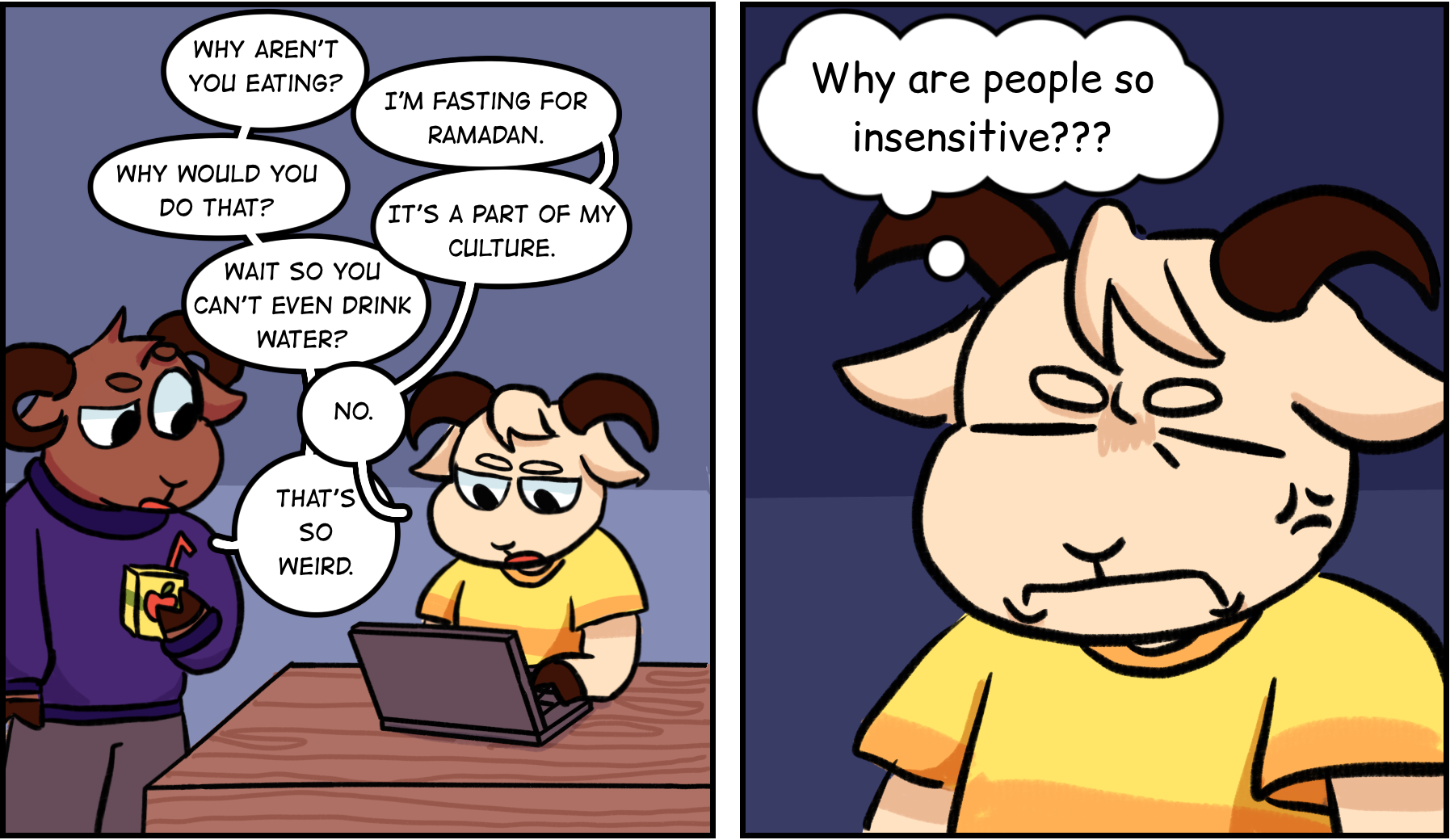
Growing up in a society that disproportionately emphasizes Christian practices, I didn’t feel like it was ok to be Muslim. In fact, I didn’t want to be Muslim for a big chunk of my life because of how people would treat me and my religion.
For instance, when people first start learning about Islam in seventh grade World History, they are taught that it is a peaceful religion. But due to Western propaganda, they either immediately forget about it or make fun of it all together. Classmates have yelled “Allah Akbar” to insult me and associate me with the terrorist stereotype common in American media without knowing that this beautiful phrase actually means “God is welcoming.”
I’ve found other students who have similar experiences with discrimination, including against their religious diets.
“A lot of kids questioned my choice to be vegetarian and wondered why I don’t eat meat,” sophomore Hindu Smiraa Sriram said. “Kids would place meat in my food or make fun of the food I ate. I don’t think people understood in elementary school how harmful their actions were, but it definitely left a toll on me.”
People within our city seem to ridicule or demonize cultures they are not familiar with.
“There have been times in early 2025 where I was wearing a Star of David and people would tell me it was demonic or that I was going to hell,” Jewish freshman Sam Frankel said. “And I’ve had a lot of people try to convert me.”
Our religions and cultures aren’t just a subject in history class. There are people in our community who celebrate and sometimes struggle to feel accepted for their religion. Our community needs to divert our attention to cultures other than ones we are familiar with. We could start by respecting other religions and asking curious but respectful questions. We can also mention important religious holidays in the bi-weekly bulletin or advocate for more diverse city celebrations.
“A couple of teenagers and I represented our Hindu non-profit organization and spoke at the City Council meeting last month,” junior Hindu Avanthika Vadapalli said. “We are currently in the works of conducting a Diwali event for the city to appreciate and learn about our culture and values.”
Our community is a mix of many diverse cultures and religions, and it’s only right that we make an effort to respect and include each and every one of them.