
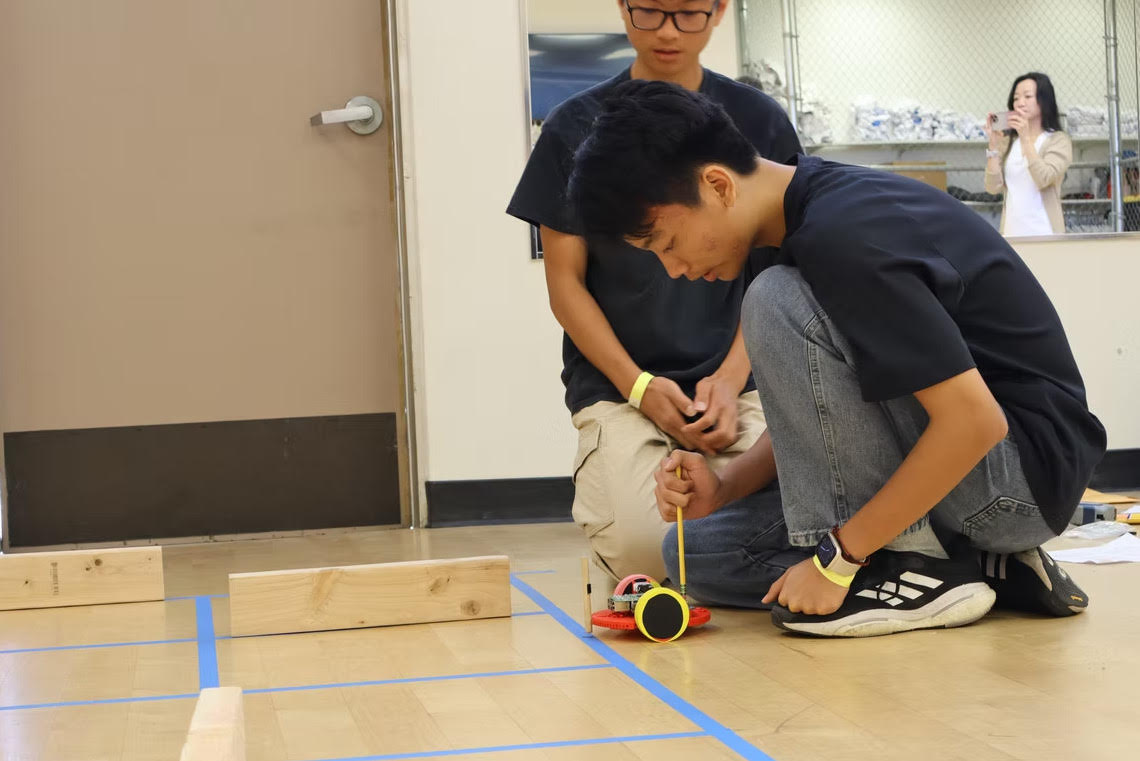
Hu was a finalist at the 75th Annual Los Angeles County Science & Engineering Fair, the regional qualifying competition for the International Science and Engineering Fair. Outside of his research, he previously competed with TC Science Olympiad.
By Ethan Lay
Staff Writer
The roar of the I-70 freeway surrounds senior Neil Hu as he hunches over an air pollution sensor, testing his filtration system against the harmful emissions from passing cars. After months of designing his device, the sensor readings finally drop, a sign that his invention is working. After extensive trial, error and innovation, Hu’s project earns him a national recognition, naming him as Top 300 of the Regeneron Science Talent Search.
“I was pretty excited and kind of freaking out,” Hu said. “But at the same time, I wasn’t too surprised since I got second at the International Science and Engineering Fair, which meant my project, on its own, was already pretty good.
The Regeneron Science Talent Search is an international science research competition for high school seniors. Bringing over 3,000 applicants worldwide, students submit original research projects online with detailed essays describing their process and results.
Judges evaluate the scientific rigor of the research, accuracy and societal impact before selecting the Top 300 to be named Regeneron Scholars, awarding a sum of $2000 to both the school and the contestant. Hu discovered the Regeneron Science Talent Search from a booth at ISEF, where he placed second in environmental engineering.
“I had a goal to get a great research project, win the science fair and do something good and find something new,” Hu said. “But, at the start, I didn’t really know what I was doing, [so] I took things very slowly and was being very careful doing it.”
Beginning in his sophomore year, Hu wanted to tackle a real-world problem and decided to focus on air pollution after noticing Los Angeles’ poor air quality. Applying his computer science skills, he developed a car filtration system to block pollutants from entering through cracks and gaps within the vehicle frame. His system removes up to 96% of harmful cabin air and works in over 90% of cars. Using multiple vehicles, he tested prototypes on Los Angeles highways, including I-60 and I-70, and measured significant reductions in air pollutant concentrations.
“I was measuring air pollutants in the Los Angeles highways,” Hu said. “But, the more I measured it, I kept on seeing more and more problems that snowballed into like a bigger and bigger project.”
Hu conducted his research independently, meaning he lacked direct support from a professor or mentor. Having over seven iterations of his filtration system, he often had to figure out the process through trial and error.
“There were a lot of difficult challenges because you don’t get the solution to the problem right away,” Hu said. ‘You just have to think and brainstorm a lot of designs; just keep on trying an idea, and if it works, cool. If it doesn’t, just find another idea and then try again.”
While his research project is complete, Hu plans to patent his filter and implement it in actual cars. Looking ahead, he wants to focus on environmental engineering and computer science, with an emphasis on broader energy solutions that integrate computational tools and technologies.
“Research is not a very linear process [and] there’s going to be a lot of setbacks,” Hu said. “For me, my [research] was not linear at all. I had so many setbacks, but I had a goal. You can only work towards that goal if you keep taking consistent steps every day. If you don’t, you’ll just stay where you are.”