By Kristal Ngo
Staff Writer
As students scramble to sign up for next term’s AP classes, College Board is preparing to launch their Career Kickstart Program, which will include the new offerings of AP Personal Finance and AP Cybersecurity.
This expansion supposedly promotes academic value and opportunity, but in reality, College Board’s motives are more profit-driven than educational. The organization may have nonprofit status, but that doesn’t mean we should excuse them for operating like a monopoly.
College Board dominates the industry, managing not just APs but also the SAT and the CSS Profile for financial aid. With the absence of competition, they can easily push high prices on students and families.
Due to College Board’s prevalence in admission processes, most high schools also have no choice but to comply with their system.
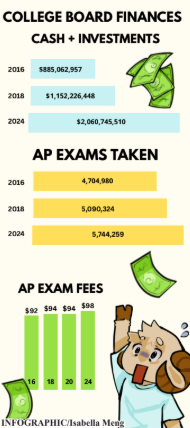
Every year, College Board accumulates over one billion in revenue from AP and SAT fees. While some of these funds go toward exam development and operations, like paying AP graders, the organization still maintains a large surplus.
ProPublica, an independent newsroom, reported that College Board’s surplus ranges anywhere from about $38 million to $146 million per year. Instead of providing higher fee waivers for students or increasing grader compensation, College Board spends its surplus on investment, lobbying and executive compensation.
AP graders—some of whom are TC teachers—earn $30 per hour, according to Forbes, which is less than what most private tutors make. Meanwhile, the CEO of the College Board has an annual salary of two million dollars.
It may seem like College Board is already doing a lot for education and affordability by reducing the cost of AP exams to $53 for low-income students. However, every time a TC student receives the reduced fee, College Board rescinds the school’s $9 rebate, which is meant to help the school pay for administering the test.
Schools are essentially punished every time they support educational access. We have to ask: is College Board still about excellence and equity in education or are they more focused on profit growth?
Keeping this organization’s actions in mind, we should pay attention to how we engage with the College Board system. Before paying $99 to $139 for an AP test or $68 for the SAT, understand why you are taking it.
College Board has built a reputation for being a path to academic success and long-term money saving. However, that isn’t always the case since many colleges do not even accept credit for certain AP exams, especially the newer ones.
According to College Board, AP Business with Personal Finance currently counts for credit at only four universities nationwide. Some universities also have strict criteria for accepting APs, such as score requirements or credit limits.
This means students could spend months preparing and pay over $100 for an exam that offers no long-term financial advantage. Instead, students should consider taking dual enrollment at community colleges like PCC, ensuring more reliability in receiving credit. Students should be more strategic and research which APs would benefit them in the long run. Our school should prioritize adopting courses that actually ensure a return on investment.
College Board wins by monetizing students’ fears and anxiety about college. It’s time we stop playing by the rules that were designed to prioritize profit over education. It’s time for an end to the game of monopoly.