
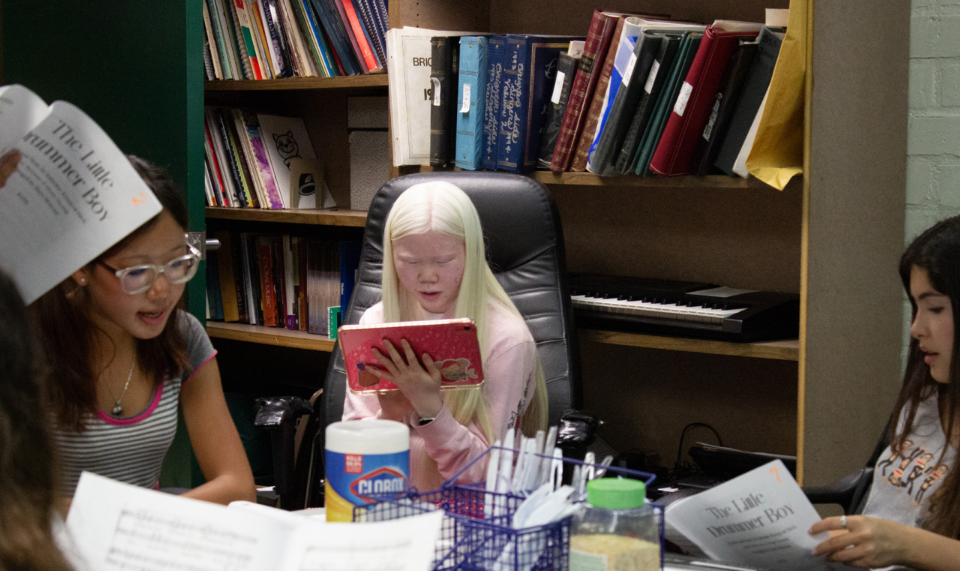
Senior Johannah Silvey (center) sings soprano in sectionals during choir class. For sectionals, each voice type was separated into rooms and practiced their individual parts of “Little Drummer Boy,” by Katherine Kennicott Davis.
By Kaelyn Chan
Staff Writer
Anxiously sitting on the porch outside her dorm room in San Rafael, California, senior Johannah Silvey excitedly awaits for a dream that walks on four legs. With the glow of a Facetime call, she shows her mom the two year-old labrador as she sinks her fingers into soft, silk-like golden fur. From this moment on, she has a loyal companion: Haiku.
“I just couldn’t really believe it was actually happening after all the years I had been waiting for this moment,” Silvey says. “Haiku came to me fully trained. The training I had to go to was for me to learn what she knows and all the commands and information I need to know now that I have a service dog in my life.”
Silvey is legally blind and has Albinism. Her vision impairment is tied to Occulocutaneous Albinism Type 1A—a condition that affects the melanin concentration in her hair, skin and eyes. Her vision is affected because of that lack of pigment.
“Because so many things require vision, tasks just as simple as reading and writing take me twice as long as the average person,” Silvey said. “I also have pretty poor depth perception, so trying to safely navigate a dark, bright or unfamiliar environment can be quite the challenge.”
Starting this year, Silvey has a yellow labrador named Haiku, who is a guide dog for blind and visually impaired individuals. Silvey applied for her through the Guide Dogs for the Blind program, and the preparation for Haiku—choosing a guide dog school, submitting an application, interviewing and waiting for a trainer’s home visit—took six months.
With Haiku, Silvey does not have to be as concentrated when she is walking around. But even with a guide dog to aid in everyday life, navigating the social hurdles provided a different kind of hardship, especially when Silvey first transitioned to high school. Silvey was placed in a table where all the VI students would hang out, but it was next to the special education students. Due to the area being secluded from the rest of the other students, Silvey felt isolated.
“Using my white cane in high school turned out to be one of my biggest regrets,” Silvey says. “Vision impairment falls under the special education category, but it’s not a cognitive disability, and we can still do everything else that everyone else can. But others just think we can’t talk, we’re deaf and I feel like I got looped into the stereotypical ‘SPED bubble.’ Even though I used a cane, it doesn’t mean I can’t talk and have a conversation.”
However, none of Silvey’s struggles have slowed her down; today, her world is only expanding. Outside the classroom, Silvey enjoys doing diamond paintings, playing piano, singing and hanging out with friends. Silvey’s vision also has not affected her future career plans.
“Mr. Sandoval was the one who inspired me to even consider becoming a math teacher and I have been so incredibly grateful and thankful to have him in my life,” Silvey said. “I remember I sent him one email giving a brief explanation about myself, and he gave me the notes in large print for me. And from that day, he always did that. He was not just a nice teacher; he was a nice person.”
Silvey wants to go through CalTeach at UC Irvine and come back to TCHS to teach.
“I also want others to see that just because of my vision, I can still do almost everything a fully sighted person can,” Silvey said. “I want to show my students to not let anything stop you from accomplishing your dreams and goals.”