
By Kaelyn Chan
Staff Writer
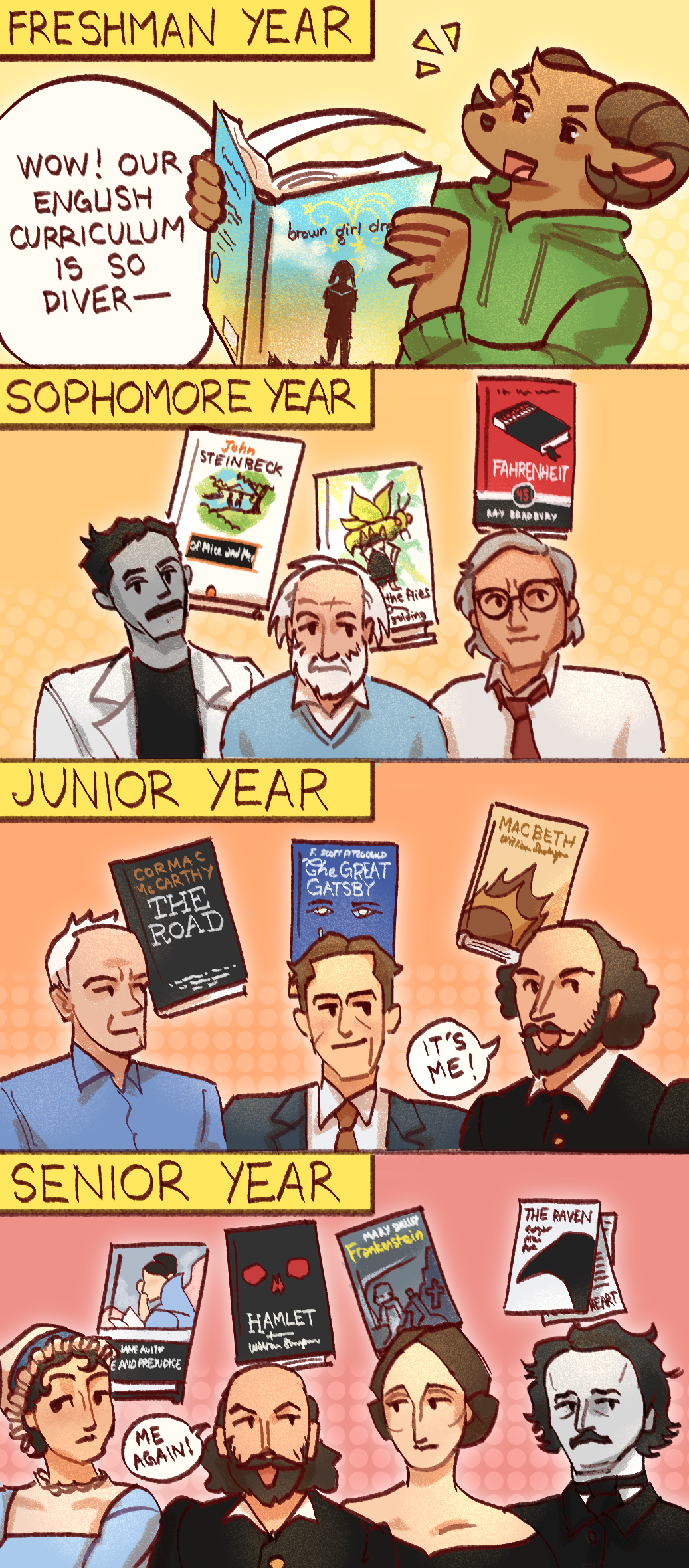
Flipping through the pages of my books assigned in English class, the same, familiar names of
William Golding, William Shakespeare and John Steinbeck dominate our school readings, bearing no resemblance to the vibrant and multicultural world waiting for me outside classroom doors.
We read some books in freshman year like “Brown Girl Dreaming” by Jacqueline Woodson, an African American author and sophomore year with “Night” by Elie Wiesel, a Jewish author, but that is just the tip of the iceberg. Our world contains a multitude of religions, cultures, LGBTQ+ themes and people navigating life with mental and physical disabilities—things that our current English curriculum fails to account for.
Breaking away from redundant books such as “Of Mice and Men” and “Lord of the Flies,” will assist our curriculum in allowing impressionable teens to see the beauty in different cultures and races. This helps our understanding of histories that make us empathetic individuals. Wiesel talks about his experience during the Holocaust in his book “Night,” but that’s just about it; we only learn about Jewish people through this tragic event, and all students take away from that book is their dark history and fail to see the beauty in the culture itself.
It is time to overthrow a broken system; schools must stop perfunctorily “checking the box” of mentioning only specific demographics and actually integrate true diversification into student’s everyday lives.
“We don’t have any books about indigenous people, and we don’t have a lot of Asian authors,” English 1 and AP Literature and Composition teacher Kendra Miller says, “We have some Hispanic authors but not a lot. I would like to have more LGBTQ+ representation, and I would definitely like to see a broader variety.”
Much of our multicultural histories are omitted from our studies because all the perspectives are from white, male individuals, such as George and Lennie from “Of Mice and Men,” Benedict and Beatrice from “Much Ado About Nothing” and Ralph and Jack from “Lord of the Flies.” Reading so much from one demographic creates a tunnel vision toward different aspects of life, which influences what we read in school. These perspectives are ingrained in our mindsets, ultimately controlling and influencing our actions.
The overrepresentation of these authors stems from centuries of racism, seeing white people as ethnically superior. Because of that, we subconsciously believe that white males sit atop a hierarchy, making us automatically assume they are the only ones intellectually qualified to adopt as a universal standard for literature. For example, Golding’s “Lord of the Flies,” forces an assumption of the universal truth of how all human beings turn evil without rules, except that the characters are 100% white, schoolboys.
When students are continuously asked to empathize and analyze books that only features characters who are predominantly white, male, heterosexual and able-bodied, we often center humanity under one demographic, marginalizing every other race as indifferent and unimportant.
As an Asian, it disheartens me to see the underrepresentation of school books that authentically depict our stories and family traditions. Since school consumes a vast majority of our developing years, I often find myself learning about all other cultures but my own, leaving me entirely shut out from the nuances of the Asian condition I long to see. Authors of similar races and backstories can foster a sense of belonging and allow a vast majority of us to truly realize what beauty our cultures are woven into society.